How to price salon services: a simple formula (with a worked example)
A simple cost-per-booked-hour formula for salon pricing, a worked example for a cut and a colour, how to set tiers including a showpiece service, and how to announce a change.
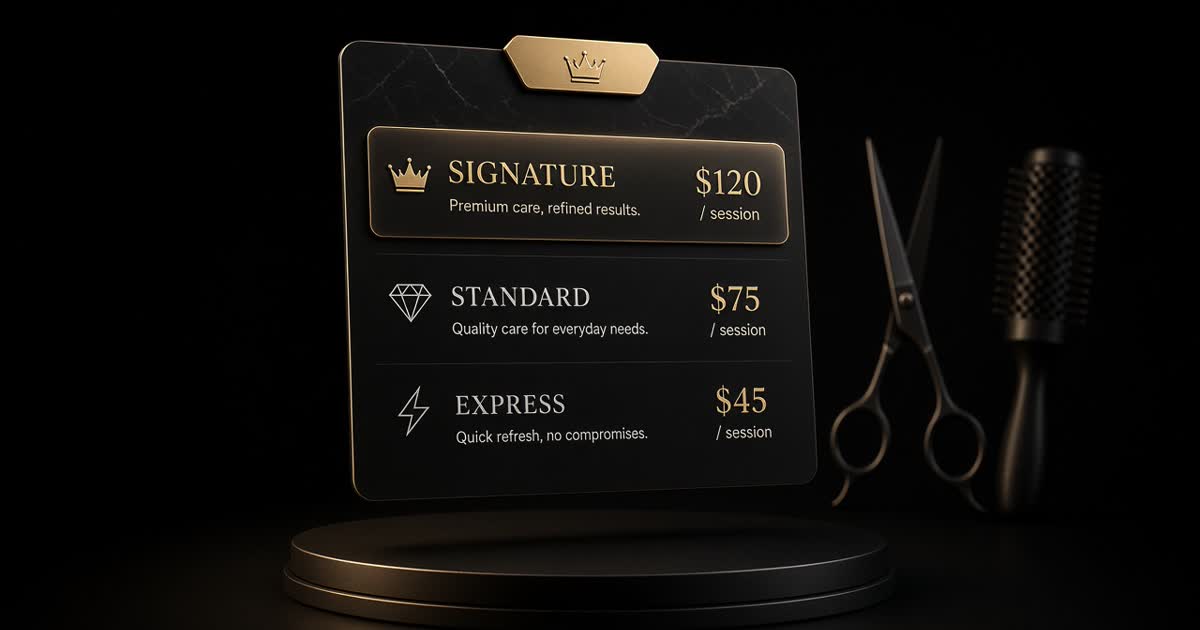
The simplest way to price a salon service is: cost of the booked hour × time the service takes + product cost + the margin you need. Then round to a number clients can remember, and put it on a clear list with two or three tiers.
Below: the formula, a worked example for a cut and a colour, how to add a showpiece tier, and how to tell clients when prices change.
The formula (cost-per-booked-hour)
- Add up monthly costs that aren't product. Stylist wages (or what you pay yourself), rent, utilities, insurance, booking software, laundry, card fees, marketing.
- Divide by productive hours. Hours the chair is actually booked, not hours the door is open. If you want a buffer for no-shows and gaps, use a realistic number (for example 70–80% of open hours), not a fantasy full book.
- That number is your cost per booked hour. Every service must at least cover that, times how long it blocks the chair.
- Add product cost for that service (colour tubes, developer, treatments).
- Add margin. This is what keeps the business alive when something breaks, and what funds training and better products.
- Round. Prefer .00 or .50 over odd cents. Clients remember "95", not "93.40".
Write it once in a spreadsheet. Revisit when rent or wages change.
Worked example (illustrative numbers)
These figures are made-up for teaching, not a recommendation for your city. Swap in your real costs.
Monthly fixed-ish costs: £4,800
Productive booked hours per month: 160
Cost per booked hour: £4,800 ÷ 160 = £30 / hour
| Service | Chair time | Time cost (£30×h) | Product | Subtotal | Margin (~40%) | Price (rounded) |
|---|---|---|---|---|---|---|
| Cut & finish | 0.75 h | £22.50 | £2 | £24.50 | £10 | £35 |
| Full head colour + cut | 2.5 h | £75 | £18 | £93 | £37 | £130 |
Check against reality: Can you deliver the colour well in 2.5 hours including consultation and processing? If it always runs to 3 hours, price the three-hour version, or shorten the offer.
If a junior does the cut, you might use a lower wage in that row. If a senior colourist does the colour, the hour cost goes up. Same formula, different inputs.
Tiers: express, standard, showpiece
One flat price per service forces everyone into the same box. Three rungs help people self-select:
- Express / maintenance — shorter, clearer scope (fringe trim, root touch-up only). Entry price.
- Standard — your everyday bestseller. This is usually the one you want most bookings on.
- Signature / showpiece — a real top option: full transformation, premium lightener + bond care, bridal trial with two rehearsals. List it first. Price it as the celebration version.
A showpiece is not a fake decoy. It has to be something you're proud to deliver if someone books it. Used well, it also makes the standard tier feel like the sensible middle — the same contrast idea behind a high "anchor" option on a menu or bakery board (we break that pattern down in our long-form on showpiece pricing).
What to put on the price list
- Service name clients actually say ("cut & finish", not an internal code)
- What's included (consultation, blow-dry, basic finish)
- What costs extra (bond-builder, toner, long hair, thick hair — only if you truly need the extra time or product)
- How long to allow
- Cancellation / no-show rule in one line (link to your full policy)
Keep the list where people book: your site, your booking tool, and a printed card at the desk. When Google or a customer asks what a cut costs, one answer everywhere beats three.
When and how to change prices
Revisit the spreadsheet when:
- Rent or wages go up
- Colour and care product invoices jump
- Your books are full for weeks and every appointment runs long (a sign you're underpriced for the demand and the time)
Then tell clients before the till changes. Short notice, real reason, date in the first line. Full templates for signs, texts and emails: How to tell customers about a price increase.
Avoid opening with a vague shrug like "due to rising costs" on its own. Say what moved (product, rent, wages), what stays the same (your stylist, your care), and the date.
A one-page checklist
- Monthly costs listed
- Productive hours estimated honestly
- Each service: time × hour cost + product + margin
- Prices rounded and written in client language
- Express / standard / showpiece where it fits
- Booking tool, website and desk card match
- Team knows the one-sentence answer if someone asks why
If you want the arithmetic and a clean list drafted from your numbers, Sam in GBot can build a price list for you to edit.
Related posts
How to reply to Instagram DMs fast: templates for prices, hours and bookings
Saved-reply templates for Instagram business DMs — prices, hours, bookings, waitlists — plus a same-day habit and what to move off chat to a booking link or phone call.
Tip screens: how to set yours up without annoying customers (Square, Toast, Clover)
How to set tip percentages on Square, Toast and Clover, when to show the tip screen, what the taxi default-tip research implies, and counter sign wording that keeps the ask fair.
Fake Google reviews: how to spot them, report them and reply (without breaking the rules)
How to spot fake Google reviews, report them for removal in Business Profile, appeal if needed, write a calm public reply, and what never to do under Google's rules and the FTC reviews rule.