Words customers actually use (inbox → replies)
Mine your DMs and booking questions for the words customers type — then rewrite jargon into plain replies, price lists and saved templates.
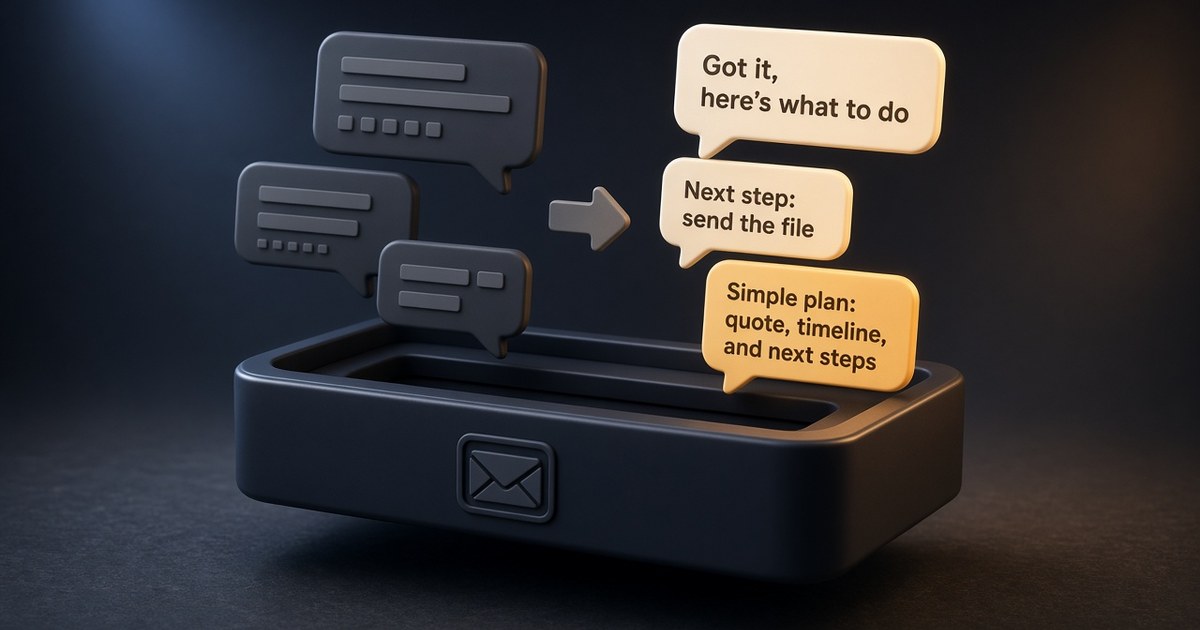
Key takeaways
- •Mine the inbox weekly: copy 5–10 anonymized phrases customers already typed.
- •Rewrite staff jargon into those nouns — then put the same words on the price list and saved replies.
- •Price list names = DM words = reminder texts. One vocabulary, every surface.
- •Strip names, phones and card numbers before any AI paste; never drop private threads into a public tool.
- •Templates live in sibling posts — this post is the method. Mia drafts; you approve; nothing auto-sends.
Customers do not search your internal service codes. They type “how much for a balayage,” “are you open Saturday,” and “can I move my 3pm.” If your price list, Highlights and saved replies speak a different language, you answer the same question twice — and they still feel unheard.
This post is the method behind our template posts: mine the words people already use, rewrite jargon into those words, then put the same nouns on every surface. It is for shop, salon, boutique and studio owners who write texts, DMs, review replies and price-list lines. It is not a brand-voice workshop, and it does not invent open rates or linguistics studies.
Where to mine the language
Look where questions already land:
- Instagram / Facebook DMs
- SMS and WhatsApp
- Booking notes and “special requests” fields
- Review text (praise and complaints)
- Till and front-desk questions staff hear out loud
You are stealing nouns and verbs, not private stories. Copy the phrase, not the person.
Privacy rule: strip names, phone numbers, addresses and anything about cards or IDs before the phrase goes into a shared note — and never paste a raw private thread into a public AI tool. If you use AI at all, paste only anonymized lines you would be fine seeing on a staff whiteboard.
A 15-minute weekly capture habit
Once a week, on a quiet open:
- Open the inboxes and booking notes from the last seven days.
- Copy 5–10 real customer phrases into a private note (anonymized).
- Tag each one:
price/hours/book/complain/other. - Add two columns next to the phrase: what they meant and your plain reply (or a link to the saved reply you will write).
Example row:
| Phrase (anonymized) | Theme | Plain reply idea |
|---|---|---|
| “how much for a balayage” | price | Point at the price-list line that uses the word balayage |
| “are you open Saturday” | hours | Hours template + last appointment time |
| “can I move my 3pm” | book | Reschedule window + policy link |
Fifteen minutes is enough. The note file becomes the source of truth for templates — not a marketing mood board.
Before → after (jargon vs customer words)
Write staff drafts the way customers already ask. Steal these pairs and adapt the brackets.
| Jargon (don’t lead with this) | Customer words |
|---|---|
| Chemical colour correction service | Fixing a colour that went wrong |
| Utilize our online scheduling portal | Book here: [link] |
| SKU replenishment delay | That one’s due back Thursday |
| Deposit non-refundable pursuant to policy | We keep the [$X] deposit if you cancel inside 24 hours — full policy: [link] |
| Complimentary consultation for densimetric assessment | Free 15-minute consult so we can quote length and density |
| Retail unit currently unavailable pending shipment | We’re out of [item] until [day] — want a text when it’s back? |
| Please advise preferred temporal window | What two times work this week? |
| Service rendered subject to stylist discretion on add-ons | Exact price depends on [length / add-ons] — we’ll confirm before we start |
Six to eight pairs like this on a staff wall beat a “tone of voice” PDF nobody opens.
One vocabulary on every surface
Rule: price list names = words in DMs = words in reminder texts.
If the booking page says “Signature Colour Experience” and every DM says “balayage,” rename the line or add the customer word in parentheses. Same for shops: “replenishment” on a shelf talker and “when’s it back?” in the inbox is two languages for one answer.
Put the captured nouns on:
- The public price list (and wall menu)
- Instagram Highlights / pinned FAQs
- Saved DM and SMS replies
- Appointment reminders and no-show / cancel notes
- Review replies when you name the service or issue
When the list and the inbox disagree, customers assume the inbox is lying — or the bill will.
How this feeds the templates you already have
This post does not dump twenty new SMS scripts. Use the capture habit, then plug the words into posts that already hold the templates:
- Instagram DM reply templates — prices, hours, booking, waitlist
- Salon appointment reminder text templates — confirm, remind, reschedule
- How to tell customers about a price increase — when the noun stays the same but the number moves
- Salon no-show policy template — plain deposit and cancel wording, not legal fog
- How to reply to a bad Google review — name the issue the way the reviewer did
- ChatGPT prompts for small business owners — when you want a draft from anonymized phrases
- How to price salon services — so the names on the menu match what people ask for
Update the saved reply the same day you change a price or hour. A clever template with last month’s number is still a broken promise.
Optional: draft from your note file
If drafting is the slow part, paste anonymized lines from the weekly note into a helper and ask for a short reply in that wording. In GBot, Mia can draft replies and templates from phrases you provide, in your voice, for you to approve — it does not auto-send SMS, Instagram DMs or emails. You still own the send button.
Delete that product sentence and this post still works: the capture habit and before/after table are enough on their own.
Related reading
- Instagram DM reply templates — where the weekly phrases become saved replies
- Salon appointment reminder text templates — same nouns in confirm and remind texts
- Salon no-show policy template — plain-language deposits and cancels
- How to tell customers about a price increase — keep the customer word when the price changes
Steal their nouns from the inbox. Put them on the price list. Answer in the words they already typed.
Frequently asked questions
How do I find the words my customers actually use?
Once a week, open DMs, SMS, booking notes, review text and till questions. Copy 5–10 real phrases into a private note, strip names and phones, and tag each one (price / hours / book / complain). Those phrases are your vocabulary.
Should my website price list match Instagram DM wording?
Yes. If customers ask for a “balayage” or “skin fade,” that is the name on the price list, Highlights and saved replies — not an internal service code. Same nouns everywhere cuts repeat questions.
What’s wrong with professional-sounding replies?
Nothing, if people still understand them. The problem is staff jargon customers never type (“chemical colour correction,” “SKU replenishment,” “utilize our portal”). Plain words get faster yes/no and fewer angry follow-ups.
How often should I update saved replies?
The day a price, hour or policy changes — and once a week when you run the capture habit. If the same question appears three times and you have no template, write it that week.
Can AI write in my customers’ language?
Only if you give it the phrases. Paste anonymized lines from your note file and ask for a draft in that wording. Review every line before you save or send it. AI without your inbox still invents brochure voice.
Does GBot send customer messages automatically?
No. Mia can draft replies and templates from phrases you provide, in your voice, for you to approve. GBot does not auto-send SMS, Instagram DMs or emails.
Related posts
Same shop task, three AIs: what to keep
One late/grace salon text, the same prompt in ChatGPT, Gemini and Claude: real dated runs, a keep/rewrite checklist, no fake rankings.
Clear price list page: so the bill matches
One clear price list for your site, booking and wall menu — what’s included, honest “from” prices, and a same-day sync checklist.
Salon appointment reminder texts: 20 templates
20 copy-paste salon appointment reminder and confirmation texts — timing, day-of notes, grace/late lines — edit the brackets and send in your voice.